What about Adding More Mobile Home Park Cooperatives in Northern Nevada?
While mobile homes offer a last resort to stable housing for many in the United States, including here in northern Nevada, challenges remain such as sudden rent hikes and evictions.
This can happen when lots are bought out by hedge funds or other private developers, often accompanied by higher fees and worse maintenance as well.
The median income of people who own mobile homes is less than half the median income of people who own single family homes, with the less educated, native Americans, immigrants and Latinos disproportionally living in mobile homes.
Despite the name mobile, though, many of these homes have never moved, and once a mobile lot is rebought, some not only lose access to the land they rented but also to their housing on wheels.
In Vermont, where a long held law requires park owners to give residents a first notice of sale and to negotiate with them if they make an offer, about half of mobile home lots are now operated as cooperatives or nonprofits.
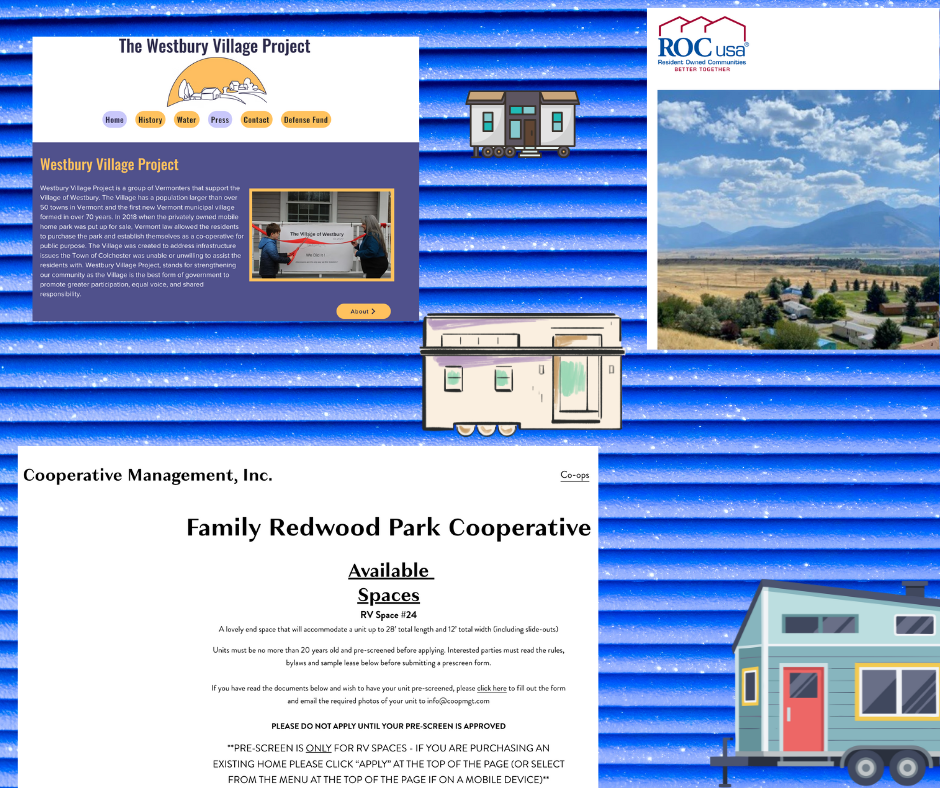
Residents of one mobile home park in Colchester, Vermont, who got bank loans and help from the regional Cooperative Development Institute and national Resident Owned Communities USA were able to purchase their mobile home park for $12 million when it went up for sale.
While there were volunteering efforts initially and an annual celebration for the new housing co-op, there were lingering challenges, as well as new ones, as the park was still considered a private enclave not benefiting from city services, even though its residents paid taxes for those, such as improving water systems, electricity, snow plowing, and road repairs.
With renewed efforts, in 2023, they decided to turn themselves into the Westbury Village. Even if not everything has gone as planned, with residents still paying for their own snow plowing and not getting lower water rates, as hoped for, they’ve forged a path from living on privately owned property to their own co-op village with 250 mobile homes.
Another example closer to here is in Grants Pass, Oregon, where the Redwood Park Estates of manufactured homes became the resident owned Family Redwood Park last year with help from the Community and Shelter Assistant Program of Oregon (CASA) and ROC USA.
“We weren't sure what was going to happen, which caused a lot of insecurity with how the future may look like for us and our families,” Berenice Maya, the Family Redwood Park Interim Board Secretary, was quoted as saying in a 2024 report from KDRV. “I honestly thought we didn't stand a chance in competing with a million-dollar company and going forward with trying to buy the park ourselves. But with little motivation and taking a chance, we came together as a community. We couldn't have done any of this without the help of many valuable staff members from ROC USA, CASA of Oregon. We also want to give thanks to our previous owners for working with us and giving us the opportunity to make this happen with the support of our community resources."
A recent video from Shelterforce is called “Remaking the Economy, Co-Op Ownership of Mobile Home Communities.”
The guests included Kelly Jensen, from the Paradise Village Cooperative in Johnstown, Colorado, a resident-owned manufactured home community where homeowners own their homes and an equal share of the land through a limited-equity cooperative.
Another speaker was Doug McElroy, from the Pleasant Park Mobile Home Cooperative in Great Falls, Montana.
“More than 18 million Americans live in manufactured housing in mobile home parks—which are de facto the largest source of affordable housing in the United States,” a preview indicated, with “a panel of folks, including residents, advocates, and technical assistance providers discuss[ing] the ins and outs of how to build land security for manufactured housing owners, by enabling mobile home communities to come together and own the land jointly.”
There’s even a local subsidized version called the Lockwood Community on Canyon Way in Sparks, which describes itself as “a unique manufactured home park. It is a non-profit cooperative community, organized under 501c3 and governed under NRS 118b and NRS 116. Residents are members of the park and own their home and hold a membership in the common areas. Members pay an assessment, rather than space rent. New members must income qualify according to Hud Income limits for low (80%) income limits.” If anyone currently lives there what is your experience like?
Would anyone in northern Nevada be interested in trying more of this model locally?
Feel free to share this article on below social media: