Our Citizen's Forum: A Daughter Feels Powerless after Her Parents Lose Their Home to Wildfire Off Deerlodge Road
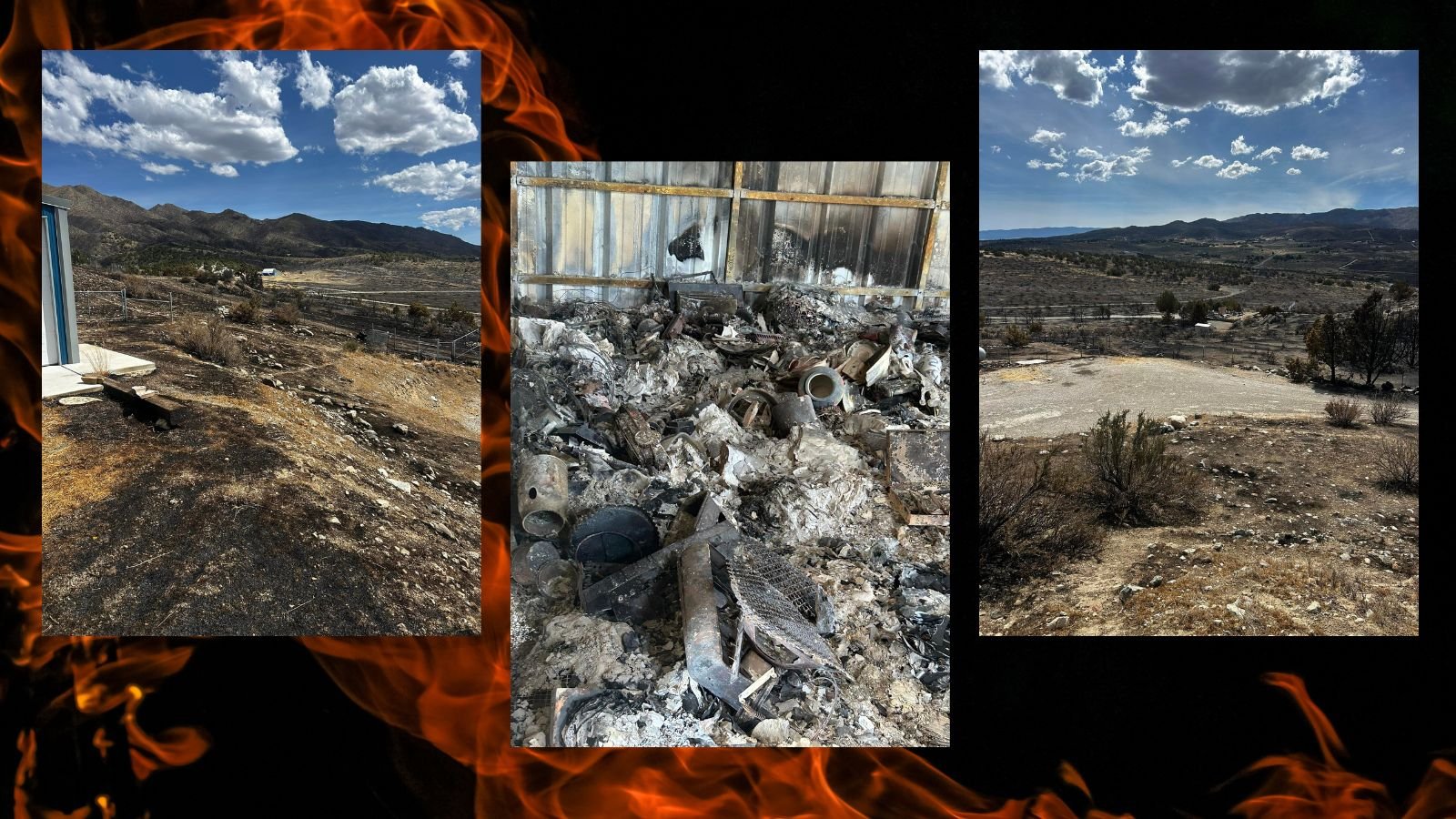
“There’s a particular kind of helplessness in watching the people who’ve spent your entire life taking care of you experience something you can’t fix,” Heidi Rhoades write of her parents having their home destroyed off Deerlodge during the recent fires.
She’s not looking for donations, she writes, she just wants to humanize victims, and feels powerless on how to help in this terrible instance as a loving daughter.
“I can’t give my parents back what the fire took. I can’t take away their grief, rebuild decades of memories, or erase the financial devastation and uncertainty that’ll inevitably follow.
I can’t make this fair. And when there’s so little I can actually do, words are one of the few things I have to give.
So, I’ve written these sentiments down…not because they can repair what’s been lost, but because their story, and the stories of so many others living through this, deserve to be told.
Forty-seven years of memories, carefully stored and kept safe. Cherished belongings whose worth was never measured in dollars, not because they had no value, but because their value lived in the people, stories, and moments attached to them.
Gone.
Reduced to little more than black soot and ash. Leveled. Demolished. Stolen.
My parents are still very much in love, even after 47 years of marriage, two grown daughters, and five grandchildren.
It’s actually pretty commonplace to catch them slow-dancing together in the living room to Percy Sledge’s When a Man Loves a Woman (their song) after all these years.
They’re the kind of people who rarely meet a stranger without somehow turning them into a friend. The kind who’ll offer you a meal, make room for you at the table, and invite you to a family holiday simply because no one should have to spend one alone. They’ve always had a way of making people feel welcome, included, and valued.
Now, I don’t say any of this to suggest that my parents are perfect. They’re wonderfully, occasionally frustratingly human. And even in those imperfections, there’s a certain sense of pride I feel when I recognize those so-called inherited “flaws” within myself (Mom’s temper and the bullheaded stubbornness from Dad). I’m proud to carry the best and worst of both of them. But perfection isn’t what makes someone a good person. If anything, it’s knowing their flaws and still choosing, again and again, to show up for others.
So when I say these two are among the very best people I’ve ever known, I promise it isn’t simply my bias as their daughter speaking.
And yet, sometimes it feels as though the gentlest people are asked to carry more than their fair share.
This past December, my mom was unexpectedly forced into retirement after suddenly finding herself in the ICU with respiratory failure; we almost lost her. At the time, we didn’t yet know that she’d contracted a very rare and difficult-to-treat disease similar to one for which the treatment itself can take a significant toll on other systems of the body.
She’s now dependent on supplemental oxygen, which we’ve collectively dubbed “her leash”. Life for them changed quickly and drastically.
My dad, meanwhile, has continued to approach work and life as though he’s still 25, despite his body occasionally reminding him otherwise. Since my mom’s diagnosis, he’s undergone two surgeries of his own, both necessary to preserve his mobility.
They were already carrying a lot.
And then, in what felt like an instant, 47 years of the tangible pieces of their life together—the things they’d saved, protected, and cherished—were gone.
And still, when another crisis came, their first instinct was to make sure everyone else was okay.
On August 11, 2026, my parents received evacuation orders as the fire threatened their area. They remained cautiously optimistic that their home and the lifetime of memories inside it would somehow be spared. But before focusing solely on themselves, they did what comes naturally to them: they made their way to every one of their neighbors’ homes to make sure each person had received the evacuation notification and to see whether anyone needed help getting out.
In a rural area, “checking on the neighbors” isn’t a quick walk next door. Homes are spread apart, and reaching everyone takes time. Still, they went. They checked on the people they knew, and they checked on the people they hadn’t even had the chance to meet yet. While facing the possibility of losing everything themselves, they were still thinking about everyone else.
That’s who my parents are.
On August 12, they learned that their cautious optimism had been misplaced.
Everything was gone.
They’re now displaced from their home, and virtually everything they spent a lifetime working for, saving, protecting, and carrying with them through 47 years together has been reduced to ash.
Because grief is one thing when something terrible happens that no one could’ve prevented. It’s another thing entirely to look at everything your parents worked for over the course of their lives reduced to ash and then hear reports that the fire may have been intentionally started.
If the accusations about the cause of this fire prove true, I don’t yet know how to make peace with that. I don’t know how to reconcile the magnitude of what so many people have lost with the possibility that it began because of the deliberate and profoundly selfish actions of another person.
There’s anger in knowing that my parents (and so many other families) may be paying an unimaginable price for this.
I’m angry for my parents. I’m angry for their neighbors. I’m angry for every person staring at a pile of ash where some piece of their life used to stand.
All of that being said, the purpose of sharing my parents’ story isn’t simply to tell you what they lost. It’s to put people, their lives, their histories, their memories, behind the numbers we so often hear when disasters like this happen. Because, heartbreakingly, my parents aren’t the only ones. There are so many families whose stories look painfully similar right now.
And, to be clear, I’m not writing this to ask for money. In fact, my parents would probably kill me if I did.
They’d insist that someone else needs it more than they do, and, knowing them, anything given to them would somehow find its way into the hands of another family affected by the fire, despite my knowing there’s no way for them to recover financially from these losses. That’s simply who they are. I’m sharing their story because behind every home lost is a family with a story worth knowing, and this one happens to be theirs.
It’s easy, from the safety of our untouched homes, to hear about a wildfire and think, “How awful. How sad.” We watch the acreage climb on the news. We see percentages contained, structures lost, evacuation zones, and maps covered in red. And without meaning to, something profoundly human can slowly become a collection of statistics.
Until it reaches someone we know.
Then suddenly, it isn’t however many acres burned.
It’s someone’s home.
It’s the kitchen where birthdays were celebrated and holidays were crowded around a table. It’s the box of photographs that can never be replaced; the Christmas ornaments made by tiny hands that are now grown; the furniture passed down through generations; the place someone thought they’d grow old. It’s decades of ordinary moments that, only after they’re gone, reveal just how extraordinary they really were.
Behind every acre burned is a piece of someone’s world. Behind every “structure lost” is a story. And behind every evacuation map are real people waiting to learn whether the place they call home will still be there when they return.
And alongside all of those stories are the people running toward what everyone else has been told to flee.
To the firefighters, first responders, emergency crews, pilots, dispatchers, police, volunteers, and every person working tirelessly to protect these communities: thank you.
Thank you for the hours you’ve spent away from your own families while fighting to protect ours. Thank you for walking into unimaginable heat, exhaustion, danger, and uncertainty because there are people and homes on the other side worth fighting for.
We know you can’t save everything. We know that sometimes, despite every ounce of effort, the fire wins.
But please know that your work isn’t measured only by the acres contained or the structures that remain standing.
It’s measured in lives protected, families given more time, communities held together, and countless people who’ll never forget that when their world was burning, you showed up.
From our family, and from the deepest place in our hearts, thank you.”
Feel free to share this article on below social media: