Kate Marshall, A Mayoral Candidate Planning Growth that Strengthens, Rather than Strains, the People of Reno
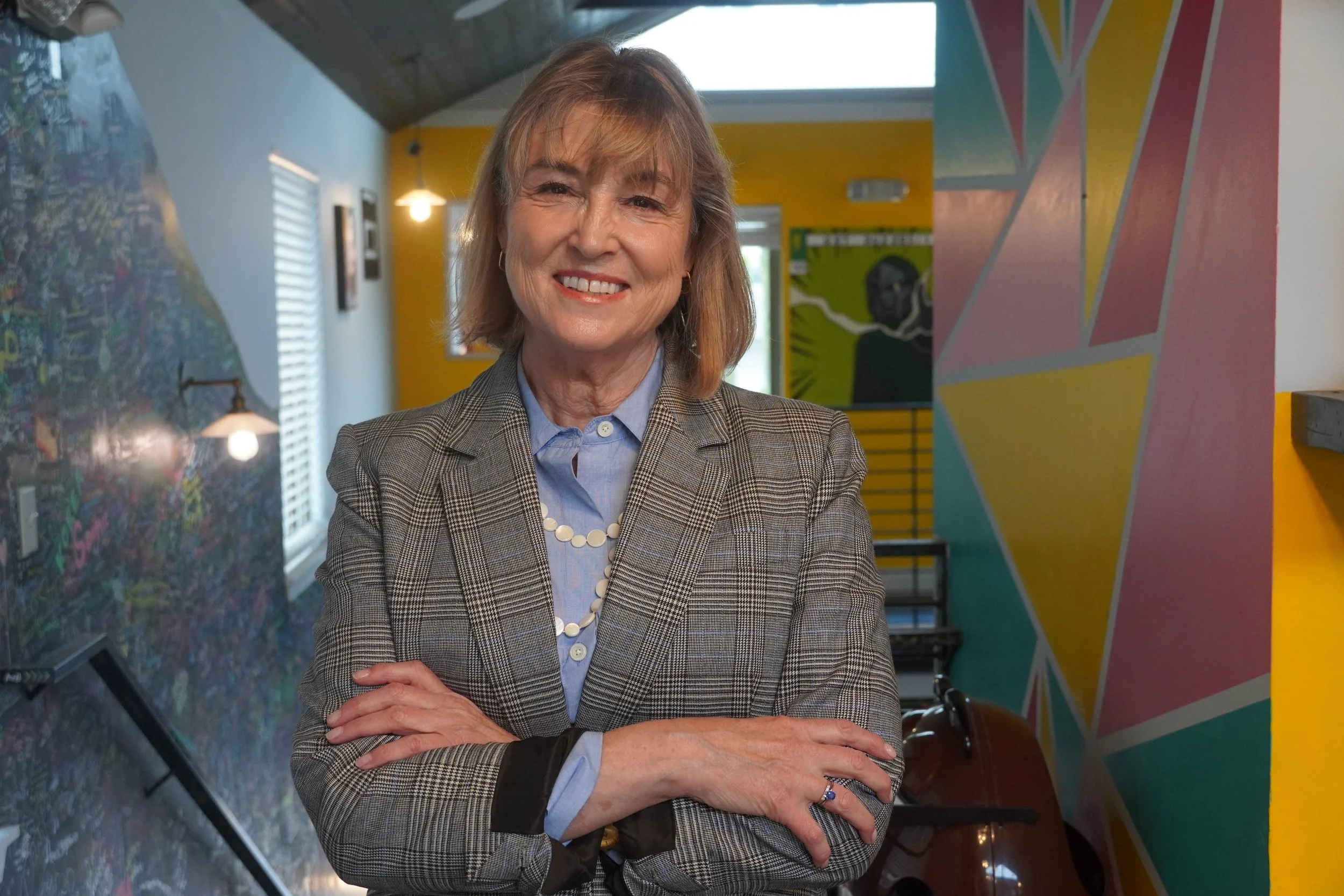
Kate Marshall is walking local neighborhoods daily to meet voters. The 66-year-old stopped teaching business law this semester at the University of Nevada, Reno, to devote more time to her busy, mindful solutions, big picture filled, campaign to become Reno’s next mayor. She says she wants to constructively change how business has been conducted of late at City Hall.
At a local coffee shop right by campus, she took one hour out of her schedule this morning to explain to Our Town Reno her views on a multitude of important topics, from managing growth to increasing access to child care and adequate housing, dealing with Flock cameras, wildfires, the Reno PD investigation and budget, the lack of revitalization in downtown Reno, encroaching data centers and plenty more.
“Reno is growing and that gives us a lot of opportunity and hope. But it comes with challenges, especially for people who live and work here,” she said at the start of our in person interview, underlining the need for a city where teachers, nurses, grocery clerks, police officers and “people making the infrastructure run,” are no longer priced out.
“I think the way the city is growing now … it’s leapfrogging over infrastructure. And so instead of the growth strengthening Reno, it's straining it. And that's because it's growth without a plan. And so I think … you need to shape growth so that you create a stronger Reno,” she explained.
On housing, she says the issue is personal to her. She grew up in San Francisco in a family with six children, with her dad a union longshoreman and day laborer who didn’t always have work. As a result, she says her family moved every time the rent went up. She remembers the phone or the heat would stop working, and she would have to move to a new school and new neighborhood and apartments.
“When someone says to me they can't afford a place to live, I know what that means from a child's view,” she says. Meanwhile, she hasn’t been impressed with the council’s often cozy relationship with developers building not so great apartments with high rent.
“I think part of what the city council is doing is a developer comes to them and then they're taking that as the plan. And so what we have is we have a series of what they call podium apartments. You can go to any city and find those apartments. They are nondescript, poorly constructed, quite frankly, and at luxury prices,” she said.
“They are often providing zoning changes or zoning upgrades,” she said of city council. “And so yes, they do have the ability to shape growth. I would suggest to you that's their job. We need to incentivize and work with developers to create entry level homes for people that fit into our neighborhoods,” with one her many ideas being to boost local community land trusts to do so.
“Our neighborhoods are fragile, so strengthen them, make sure the housing fits within them. Make sure that the people then who are buying those homes can feel connected and invested, and then put your density along your major bus routes as well,” she said of the need to better connect residents to services and businesses throughout Reno.
On the issue of child care in our city, she said it’s “more expensive than UNR and it is literally a choke point for our workforce and our employers.” Marshall says she would work with local entities trying to address child care, with an idea to “repurpose some of these school buildings that are no longer being used… The classrooms are child ready, and I believe we can repurpose them for three and four year olds.”
“It may be raining today, but I will tell you that the lack of single dispatch and regional dispatch is alarming,” she said in terms of preparations for what could be another bad wildfire season up ahead, listing another topic she cares deeply about and believes she could change for the better if elected mayor.
Two of her main June primary mayoral election competitors are council members Devon Reese and Kathleen Taylor who have been in the majority of most council decisions in recent years. Both of them were initially appointed as replacements by other council members to join them.
When asked about data centers within city limits, Marshall said she has “said the same thing from the beginning, and that is that I don't believe they belong in city limits. The city council has really abdicated its responsibility. They have allowed these data centers to go forward. The planning commission approves them, and no one appeals it. A city council member could have appealed it,” she said of several data centers within Reno already underway.
“They'll all say to you,’ ah, well it’s the state that gives the tax abatements.’ Okay, if you read the law, the law says that the city can go to the state. And when the state is handing out those tax abatements, the city can object,” she said of a different approach she would have taken.
On downtown blight and revitalization, she says she’s been dismayed “the city council is not using the tools the state gives them for blight. The state allows them to charge more, charge more often and use tax liens and they are not doing that. I do think that part of the answer is not only to address blight, but part of the answer is we need a permanent art presence … And I think that there is the energy and attention in the private sector to create that,” she says of having a permanent arts complex downtown which could create “placemaking change.”
She says the council should look into perhaps closing certain blocks to traffic, with more year round walkable and inviting spaces. “That is all the city's job. So when I hear the city council throw up their hands, I'm shocked and dismayed,” she said repeating that word. She says it’s the responsibility of the city and not the private sector to give downtown the boost it needs.
The never ending reconversion of the former Harrah’s she says points to banks unwilling to take the risk in providing bridge financing for that massive project, which has become a dark hole for our downtown’s present. “We as a city need to do things to change that dynamic,” Marshall said.
Concerning Reno’s contract with Flock Safety for surveillance cameras while supposedly not sharing data, “the problem is that we have seen across the country that Flock is in fact violating those agreements and sharing data,” Marshall said, with dozens of cities pausing or canceling these contracts. “So what's happened with the city council is that they've approved an expansion of the use of Flock cameras without doing an investigation to determine if Flock is currently violating the city contract, as they have done elsewhere... I don't think that people in Reno or elsewhere would appreciate having their data sold or provided to federal agencies without their consent. And the law says that it should not be. So that needs to be investigated before you expand a contract.”
On helping the unhoused, one priority Marshall gave would be trying to help veterans in that difficult predicament.
“I do think that there's federal, state and local resources,” she said. “There's also private resources of people who recognize that people who have served this country don't belong in the streets. That's an embarrassment. And I think there are probably maybe 50 to 70 homeless vets in our community now. There are programs that are trying to address that. I think if we pull those people and resources together, we can solve that. In the first 18 months I'm in office and if I'm fortunate enough to be in office, I will do that because I think you have to start somewhere.”
We asked about decorum at city council meetings to which she responded “they are picking on each other and are trying to make political points. And I think that decorum and respect are very, very important, so that debate becomes productive. I think one of the things that the mayor can do is to support the other council members in their ward so that they feel heard and that they can have successes in their ward.”
Even if the mayor has just one vote equal to other council members she says a mayor can uplift other council members, and “earn credibility throughout that council so that then we can all start rolling in the same direction.”
She sees a current failure by council to abide by its master plan, adopted in 2017 and updated in 2021 to manage growth and sustainable development.
“I think that the council needs to begin to refer back to the documents that it created to help guide and then start to move from that place and not simply throw it against the wall and see what sticks or what someone's current passion is at that moment,” she explained as to how she sees the ReImagine Reno Master Plan.
Again, she stressed seeing the big picture.
“You have the opportunity for kind of hamster wheel management where it's just whatever the crisis of the day is and we're running as fast as we can,” she says of a leadership style which will not be hers.
“That makes people feel very busy and accomplished. But it doesn't move your priorities, your longer term priorities, which requires some focus and which will not happen in a week or month or six months... I think that's part of the problem with the city council. They're not moving forward on the larger themes because they're not recognizing their own master plan and the importance it plays in what they're doing.”
Marshall hasn’t been impressed by the council’s mute like reaction to the ongoing and still undisclosed investigation of police chief Kathryn Nance and five other officers, which has put them all on paid leave.
“It’s a lack of leadership that you see the city council basically looking the other way and denying any responsibility or accountability for the fact that one of their key priorities, which is to keep people safe, is now in disarray, to put it in the most positive way possible,” she said.
“And then to have the answer be, well, let's give them $8 million without accountability is wrong ended. You don't throw money at an organization which is dysfunctional at best without figuring out what is the cause of the dysfunction and how do we right it, and therefore then what will we fund? It is absolutely wrong,” she said of current discussions to increase the Reno PD budget.
“We need a functional police force,” she said. “Often a functional police force requires community involvement and investment and requires community collaboration. And those things are from the outside looking in, missing currently from our police force,” she explained as to ways she would try to impact change with Reno PD going forward if elected mayor.
To those who say she isn’t born and raised here or from multiple Nevada generations, she says her mother’s family arrived in California before it was a state so she understands “that kind of pride.”
Marshall says she chose to have her second child here nearly three decades ago.
“I came here and I've never looked back. I love this town. And I think when you choose something, you are perhaps its biggest cheerleader,” she said.
Working in D.C., she says it wasn’t her place and that she’s a “Western person.” Her grandfather came to the United States as a child from Mexico with a storied background with his family having fought with Pancho Villa, basically chased out, while her mother’s family was in California in the 1840s.
While still in our nation’s capital, Nevada Attorney General Frankie Sue Del Papa offered her the opportunity to start an antirust unit here. After drawing up pros and cons with her family, she says Reno, with its outdoor accessibility and hiking opportunities, won out.
Marshall went on to be treasurer of Nevada from 2007 through 2015, Lieutenant Governor from 2019 to 2021, during which she’s especially proud of having created a state-managed “dark sky places” program, and senior White House advisor to governors from 2021 to 2023.
In 2011, she lost in a special election for Nevada’s 2nd congressional district to Republican Mark Amodei in what was then a ruby red district.
“That resilience is part of what frames you and makes you,” she said of lessons learned from that electoral defeat. “And I think most of us have at some point in our lives had that experience. I share that with people. I think it makes me more resilient and more steadfast.”
Her background as a treasurer helps she says to be aware “of financial tools that cities can use and various opportunities to use them. I'm also aware of how to work with the state legislature to try and move things forward, and I do see the opportunity for regional collaboration that becomes critical.”
When asked about when people wonder why she would want a city position at this point of her journey which also included Peace Corps in Kenya, she responded “it’s the harder job.” She believes other layers of government have ceded their responsibility “to move this country forward.”
“People live in their housing, their transportation, their public safety, their affordability. It is here, it is in their town, it is on their streets. It is at their stoplight,” she said.
“You can actually make change here and actually improve people's day to day experience. And I think in this country at this time right now, that's what we need to do is show up. And like I said, I've been here 29 years and I really love this town,” she concluded hoping in the next years she will have local leadership impact as the Biggest Little City’s mayor.
Feel free to share this article on below social media: