Washoe County Seeks More Help and Support for its Child Fostering, Adoption and Mentoring Programs
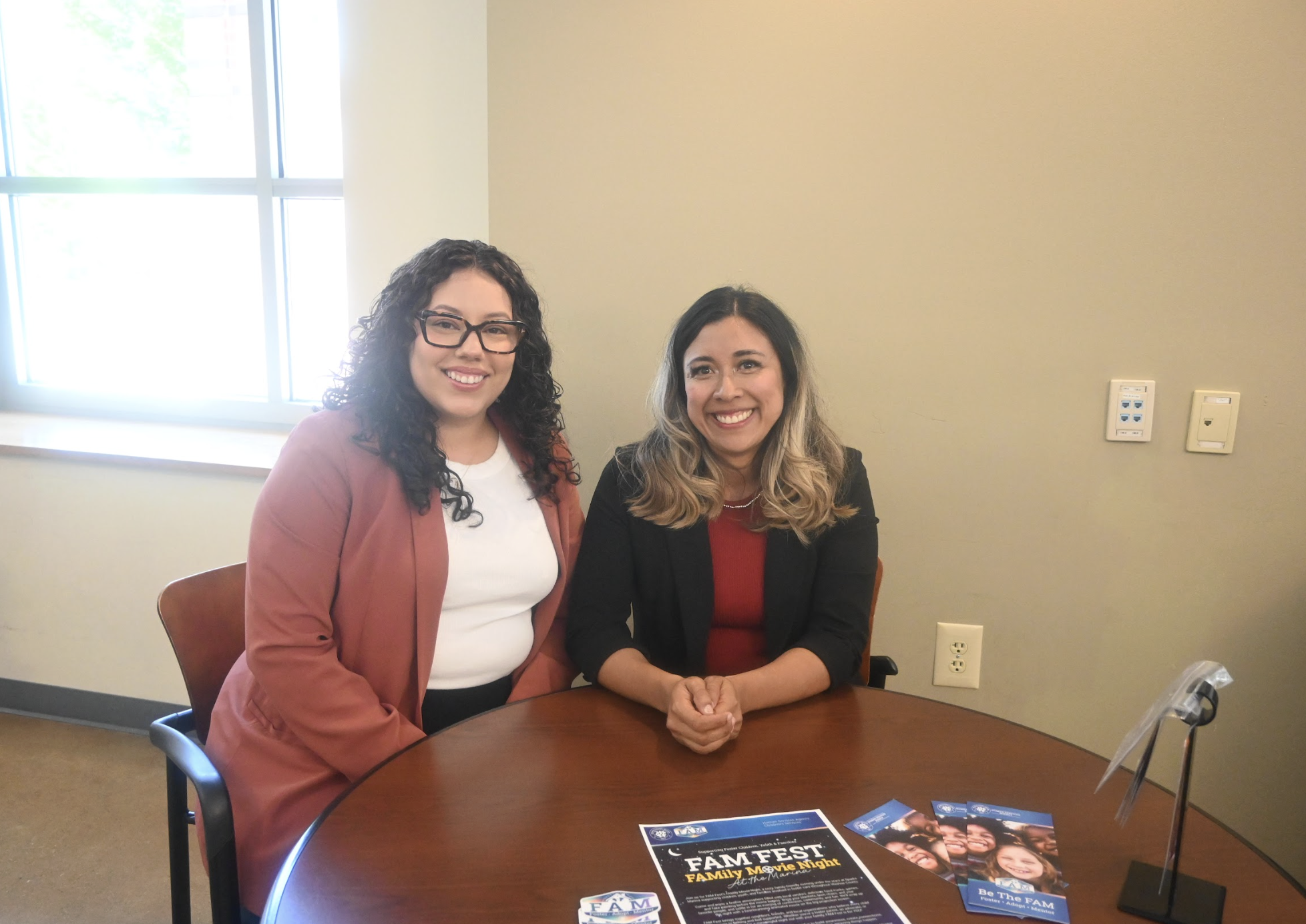
Yasmin De Peralta (left) and Kate Alvarez (right) are recruiters and trainers for foster care families. Photo and reporting by Isaac Cancoby.
Right now, over 600 children under 18 are estimated to be in the foster care system in Washoe County, while there are about 400 licensed foster families.
“We don’t have enough,” says Kate Alvarez whose job is recruitment and training of these families. “And we do want to emphasize that we do need more families if they’re able to – or are interested in learning how to support children in foster care.”
“Our goal is to essentially place children in foster care and supportive, living homes. We want them to be able to have stability,” her colleague Yasmin De Peralta explained. “We have a whole team called the Spark Team and they are essentially, like, your support placement, retention, kinship advocates that work with our caregivers as well.”
Both employees are listed on the bethefam county website as FAM Recruitment and Training. FAM stands for Foster, Adopt, Mentor.
“We don’t just need foster parents,” De Peralta explained. “We also have our mentorship program. We also have the need for respite. It’s essentially a babysitting service. Foster parents get burnt out, they need a break. If you’re able to do that, then that’s another way to get involved as well.”
A unique challenge is finding families who can welcome children with neurodevelopmental disabilities. There are also needs for emergency placement, which is a short term plan to shelter a foster child from two to six months.
“Right now, obviously we have a need for more foster homes,” Alvarez said. “So kids are staying in emergency placements longer than six months because we don’t have enough homes.”
De Peralta says anyone interested can reach out via the bethefam.washoecounty.gov website to have an initial meeting to find out about different ways to help kids in need.
“We welcome everyone,” De Peralta said. “We actually need more LGBTQIA plus families and individuals to become involved in our mentor program, our adoptive program, and fostering as well. Our training is inclusive. We also are very big on respecting pronouns. If you have specific pronouns that you would like to be addressed by, please let us know… We welcome everyone.”
“I want to add that we do have youth, as one can imagine, that identifies with the LGBTQ community,” Alvarez said. “So we really want to place children where they feel welcome, seen, and loved. So if we can find a caregiver or a mentor that shares that, we want that.”
De Peralta acknowledges even the scarier parts of the process.
“Yes, it can be scary to bring a child into your home that you know little about, especially if they're a child that comes home at two in the morning and you know absolutely nothing, but it can be very rewarding. You learn so much, not only about the youth that comes into your home, but about yourself and about your family. You really learn resiliency and you learn how to step up for others when they haven’t had it for themselves,” De Peralta said.
Alvarez previously worked at the emergency child shelter Kids Kottage, after she graduated college, always wanting to “advocate for the most vulnerable population.”
Still, her own job has many difficult moments.
“The hardest thing for me was telling children that they couldn’t reunify because their parents’ home was not safe,” Alvarez said. “And that was very difficult for them to understand and so … having to step into that role, explaining that and talking to their therapist to help them process that as well and accept it… children struggle with that. They always want to go back to their caregivers and back to their original home, and their school, their neighborhood and everything. So, it’s a very difficult thing to understand when children are small.”
De Peralta grew up in a rural community where social services were scarce. Because of the lack of social services, she says kids in need were often uprooted to other locations.
“A lot of these kids that I grew up with lost connections,” De Peralta said. “I also grew up around foster youth as well. So that really motivated me to get involved on the other end.”
“I would say that a lot of people might be afraid of working with the government,” Alvarez admitted as well. “There’s a lot of hesitation. That’s why … we really work hard to do outreach and ask the public for questions that they might have and answer them because we want the public to know it’s not a bad thing to work with us. You’re supporting the children. We are doing good work and we do need community involvement in order to be successful and offer that effective and efficient work for the children that we serve.”
“The other thing would be the emotional toll it takes,” De Peralta said. “This is hard work and it takes a toll on our caregivers. Sometimes you get really bonded with a child that's in your home and they reunify… That can be hard as well.”
Alvarez stresses the importance of collaborations, community donations and partnerships to help with their overall goals as well.
“We don’t have enough funds to cover, like, advertisement opportunities or other ways like social media,” Alvarez said. “We’re really trying to grow in that area to educate the community, to let them know, we need you and these are the options in which you can support us and just become involved. We’re working in different areas but definitely I would say the highest need is just collaborating with more community partners that are able to let us use their advertisement space or support us in other ways so that, you know, we’re not having to struggle to find the funds with fundraising or securing sponsorships in order to reach that goal.”
Alvarez points out that not being a non-profit makes it difficult to secure sponsorships and that the misconceptions of being involved with the government continue to seep through with funding opportunities as well.
“Some community partners don’t want to work with the government and so that’s another barrier that we have to try and find a solution for,” Alvarez said.
Alvarez also mentioned that they have a high need for therapeutic services for foster children. But again, the funding constraints put them in a bind.
“A lot of things that we see… that we are needing within our own community are also impacting our own agency,” De Peralta said. “For example, housing within the community is a big need. It’s really hard to work with families, that their main thing may just be that they need a house, they need somewhere to reside and we don’t even have enough. So then when we go to our community partners, they’re in the same boat as us.”
Interested families who want to help can call (775) 337-4488 while potential sponsors can also reach out to assist with the upcoming August 29th FAM Fest taking place at the Sparks Marina.
Feel free to share this article on below social media: