We Finally Got ADUs, but with many restrictions. What About Following Portland’s Lead to Now Get Cottage Clusters?
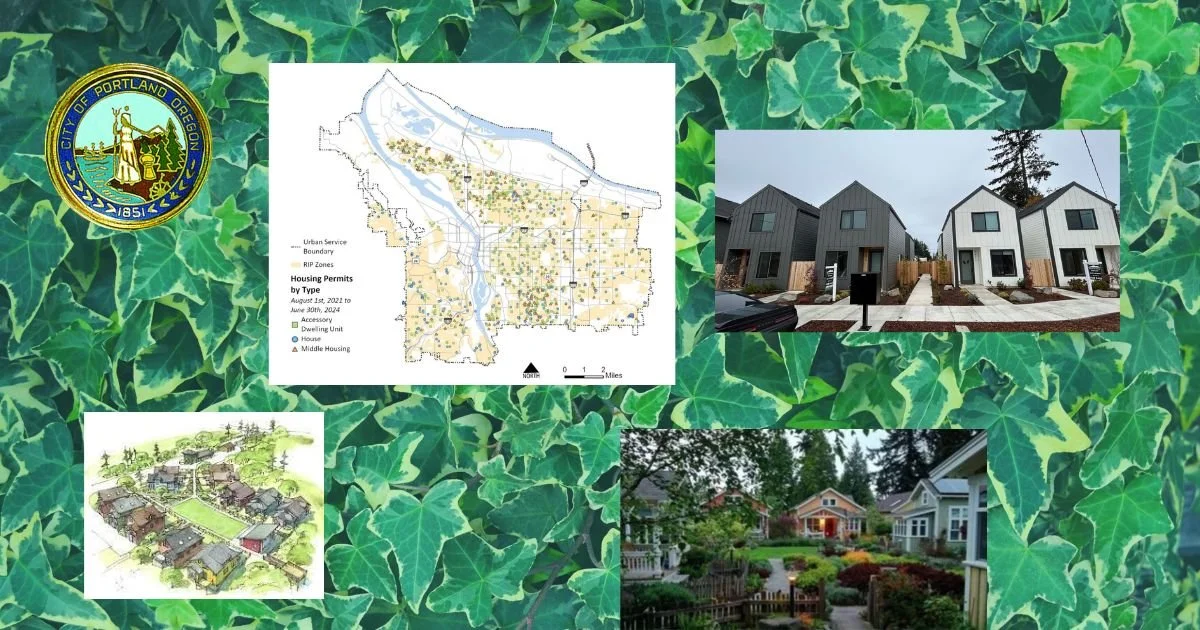
There was a time, not too long ago, Reno was being touted as having a “Little Portland.” In one quick rush, we got some Sizzle Pie, Pine State Biscuits and a See See Motor Coffee Co. What we didn’t get unfortunately was progressive housing policies.
While our City Council at first rejected so-called backyard granny pods, despite our constant opeds in favor, and the urging of many community advocates, it finally relented last fall, approving an ordinance allowing ADUs on single family lots, with powerful people in town previously opposed mercifully giving in.
The approved ordinance number 6727 though has many restrictions including “no more than one ADU shall be established on the same lot… ADU height shall not exceed the height of the existing primary residence… The minimum lot size shall be 5,000 square feet … One designated parking space shall be provided on-site.”
Portland, meanwhile, since changing its zoning rules in 2020 has been going full throttle with these, as well as fourplexes, even sixplexes, with townhouses stacked one behind another going deep into a lot, and even bigger cottage clusters, with individual homes built without their own street front, and the cottages sold on their own.
According to wording from the City of Portland “cottage clusters are groups of relatively small homes oriented around a shared common space such as a courtyard or garden. A cottage cluster is defined as a group of three to 16 detached dwelling units on one lot with a footprint of less than 900 square feet each.
This type of development option is allowed in most zones that allow residential development.”
It’s being called a revival of starter homes, with prices for these often selling for $250,000 to $300,000 less than neighboring single family homes.
“The City permitted over 1,400 Accessory Dwelling Units (ADUs) and middle-housing units between Aug.1, 2021, and June 30, 2024, in single-dwelling zones,” the Portland.gov website indicates. “Middle housing is now the most prominent housing type being built in single-dwelling zones, with the majority of production happening in inner east Portland.”
“The Residential Infill Project is delivering on its purpose,” Patricia Diefenderfer, Chief Planner of the Bureau of Planning and Sustainability, is quoted as saying. “We are seeing a meaningful expansion of housing options in some of Portland’s most desirable neighborhoods, making it easier for Portlanders to find homes that meet their needs.”
Denser, pedestrian heavy, middle class neighborhoods are also encouraging more grocery stores, small shops and cheap but healthy restaurants to set up business, which are lacking in many of our own neighborhoods. Imagine if that could be part of the Midtown and Downtown revival, and in more affluent residential neighborhoods, rather than barely used festival grounds and parking lots catering to a casino, overpriced restaurants for the wealthy who drive into those areas, and our elected officials fixated on approving big sprawled out suburbia type developments without the car and public transportation infrastructure needed for those.
There might have been a moment perhaps to have more of a Portland feel to our local quality of life, with more affordability, quaintness and walkability, rather than shoddily constructed drabness and ever more traffic headaches, but it seems post Great Recession that we missed it. The current elections could set the tone for a new direction, though, so it’s important to look closely at who we elect to the mayor’s seat as well as Wards 2 and 4, and how they would actually help shape a better future for all of us, not just the developers who wholeheartedly back some of them.
Feel free to share this Ideas for Progress oped on below social media: