International Students Try To Persevere at UNR Despite Mounting Challenges and Insecurities
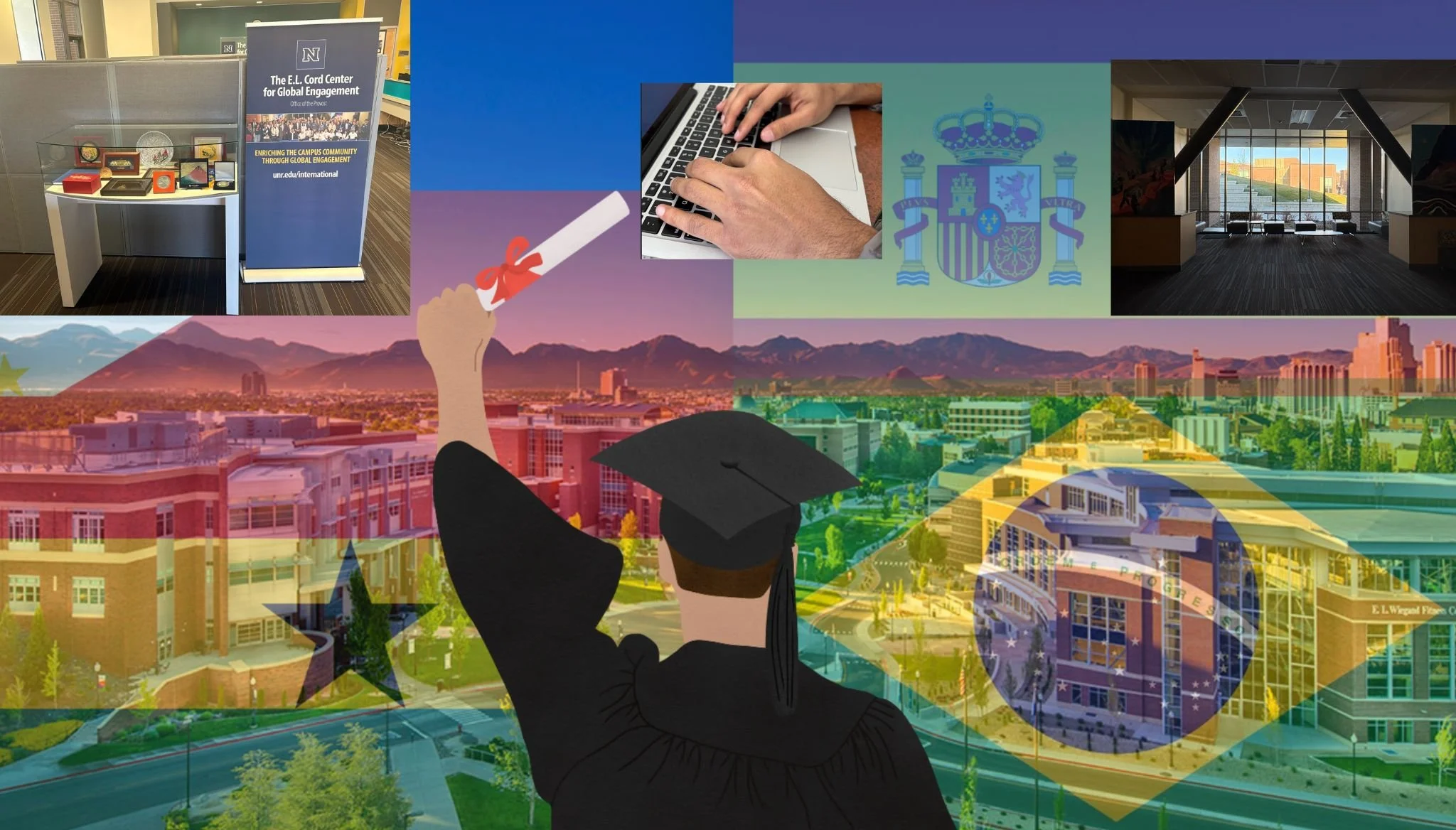
Reporting, photos and graphic by Dallasia Samuels
In hushed conversations, international students at UNR often explain how they now no longer go to academic conferences or on vacations which require airport travel. Some don’t go out at night for fear of getting caught up in immigration crackdowns. Others have asked us to scrub quotes from articles in which they were cited espousing pro Palestinian views. Campus protests related to Gaza, which used to be filled with international students, stopped taking place in 2025. Many international students have entirely shut down their social media accounts.
Nationwide, applications for F-1 student visas are dropping precipitously. New international student enrollment at U.S colleges declined by 17% from fall 2024 to this most recent semester.
One graduate student from India pursuing his second master’s degree here at UNR, in hydrology, decided to push through with the experience despite all the challenges. He wonders though if it will be worth it for others in India, facing a lengthy visa process and growing uncertainties.
Speaking anonymously, due to fears of reprisals, he said he felt genuinely happy once he made it to Reno and excited to begin his studies, noting that the opportunity made him “feel special” and accomplished.
The U.S. has long been one of the most sought-after destinations for students pursuing higher education. According to the latest estimates, 1.1 million international students were enrolled in U.S. institutions during the 2023–24 academic year, boosting the U.S. economy by over $50 billion, with India the top country of origin.
The student said he started his process before knowing there would be a new federal administration creating this new climate of growing uncertainties.
Before securing a visa, prospective students must first apply for and be approved for an I-20 form. According to the U.S. Department of Homeland Security, the I-20 is an official document required for all international students to be accepted and eligible to study in the United States. It includes important details such as the student’s program of study, length of enrollment, and proof of sufficient financial support. International students cannot apply for an F-1 student visa, which is a separate document, without first receiving an I-20. Once the I-20 is issued, students are expected to schedule their visa appointment and submit their application quickly, as delays can affect their ability to enter the country and begin classes on time.
Oftentimes, students are accepted into programs, but need to defer or cancel when their paperwork doesn’t arrive before classes start.
Waiting times for visa interviews can take up to six months. According to the U.S. Department of State, wait times vary, and any estimates listed online do not guarantee an appointment. In some cases, a rejected visa application can prevent students from applying again. In addition, applicants may be required to travel long distances if they don’t live in major cities and wait in long lines to attend appointments. There are also application fees, and additional expenses if students seek secondary support from an agent or immigration lawyer.
The student we spoke with says he is thriving and feels supported, despite the initial culture shock and added political uncertainties. He is involved in many student organizations, including the Graduate Student Association (GSA) and badminton club.
“At UNR, I haven’t felt anything like being left out or alone. The community and the students, whether they are international or US students, are quite engaging,” he said.
“Understanding the academic expectations of professors was a challenge, especially with the language…Back in my home country, my course work was quite intensive and the master’s work was there, so it definitely created a good foundation in understanding the subject very well,” he added.
He knows his position is tenuous though. He shared a story of how one of his friends, also an international student, lost his student status due to sudden cuts in federal funding. His friend had been working for a company that relied on government grant money which suddenly evaporated. When that support was withdrawn the company could no longer provide financial assistance or academic support to their international students. Without this funding, the student was unable to continue his studies, highlighting how dependent international students can be on factors that are not at all in their control.
Mehmet Tosun, an economics professor in the College of Business, and the Director of The E.L Cord Center for Global Engagement office, works closely with international students, in what is an important position.
“A lot of universities are facing pressure in domestic markets and want to admit more international students,” Tosun said of the need to recruit more international students despite increasing challenges.
The Center for Global Engagement plays a crucial role in supporting international students and fostering cross cultural connections on campus. This space also hosts important events and key speakers that share resources related to international students, study abroad opportunities, and academic collaboration. It provides a sense of belonging for people who are navigating a new country and education system. Having a dedicated environment like this helps international students feel seen and supported, while also encouraging cultural exchange and global awareness among the wider campus community.
As universities compete globally for students, institutions such as UNR need such initiatives to remain appealing. Many international students experience feelings of loneliness, making it essential to provide opportunities for them to socialize and interact.
The student from India talked about how clubs and organizations on campus like United Well Nation, which is open to both domestic and international students, and the Global Student Association help students feel a sense of belonging. They create spaces where people can connect across cultural differences and share experiences, from adjusting to new diets to navigating life in a different country. At the same time, factors like inflation and changing exchange rates can make living abroad even more stressful, showing how both social support and financial stability are important for international students trying to feel at home.
“In a lot of countries, higher education is free to students. As part of that, the school cafeterias are either free or at a very low cost,” Tosum said, with high costs here startling many foreign students.
He explained how the main motivator of studying internationally included curiosity, entertainment, and entrepreneurship.
“I would like to see more international students. I would like to see more global engagement. I like when people feel good about the US in general and our institutions,” he said.
Aaron Laden is an adjunct professor who mentors and empowers English Language Learners, or ELL students. Through his teaching and mentorship, he emphasizes practical strategies for learning English while also fostering a sense of belonging and empowerment among students navigating a new cultural and educational environment.
“Basically, I teach people who are learning English as an additional language to what they already speak,” he said. “I have a Master’s in teaching people English as a second language.”
Laden compares the experience of being an international student to playing a new board game that everyone else already knows. For newcomers, the rules are rarely explained, leaving them to figure out strategies on their own. The complexity feels infinite, with social norms, language, and cultural expectations all intertwined, and every move requiring careful thought.
Some of the foreign students at UNR include those in study abroad programs, or more specific studies, such as a tourism major mandating an international experience. One foreign student explained that their primary goal was the overall experience, saying they “just wanted to see what America was like.” While coursework and academic obligations remain part of the exchange, for this category of students, the focus is often on immersing oneself in western American culture, exploring everyday life, and gaining a broader perspective, rather than prioritizing grades or specific academic achievements.
The University of Nevada, Reno previously offered significant support for international students through the Intensive English Language Center (IELC), a pre-university English program designed to help students improve their language skills before beginning regular courses. This program was an important resource for incoming ELL students. However, the program became underfunded and eventually closed during the pandemic era.
Living abroad also presents practical challenges beyond language, such as adjusting to new food environments. Many foreign students say they struggle to maintain a healthy diet while missing the cuisines they grew up with. UNR is technically in a food desert, with limited access to grocery stores and dining options that meet students’ needs. The campus dining hall and nearby restaurants are often underdeveloped, and many options are fattier or saltier than what foreign students are accustomed to.
For those who eat halal food, finding such items adds an additional layer of difficulty, making meal planning and nutrition a constant challenge.
After graduation, foreign students can get up to three years to stay in country if a company hires them with options to transition to other visas or enroll in even more studies.
Looking five to ten years into the future, the student from India we interviewed envisions himself as a hydrologist either still here or in India. Ultimately, he plans to open his own conservation-focused farm in his home country, securing funding and developing initiatives that address sustainable water management and environmental stewardship.
“Your mindset should not be affected because of the surrounding environment,” he said.
Feel free to share this story on social media below: