Criss Crossing Through Iglesia Ni Cristo, from the Philippines to Northern Nevada
Reporting by Bobby Diaz, James Perez and Elijah Reyes
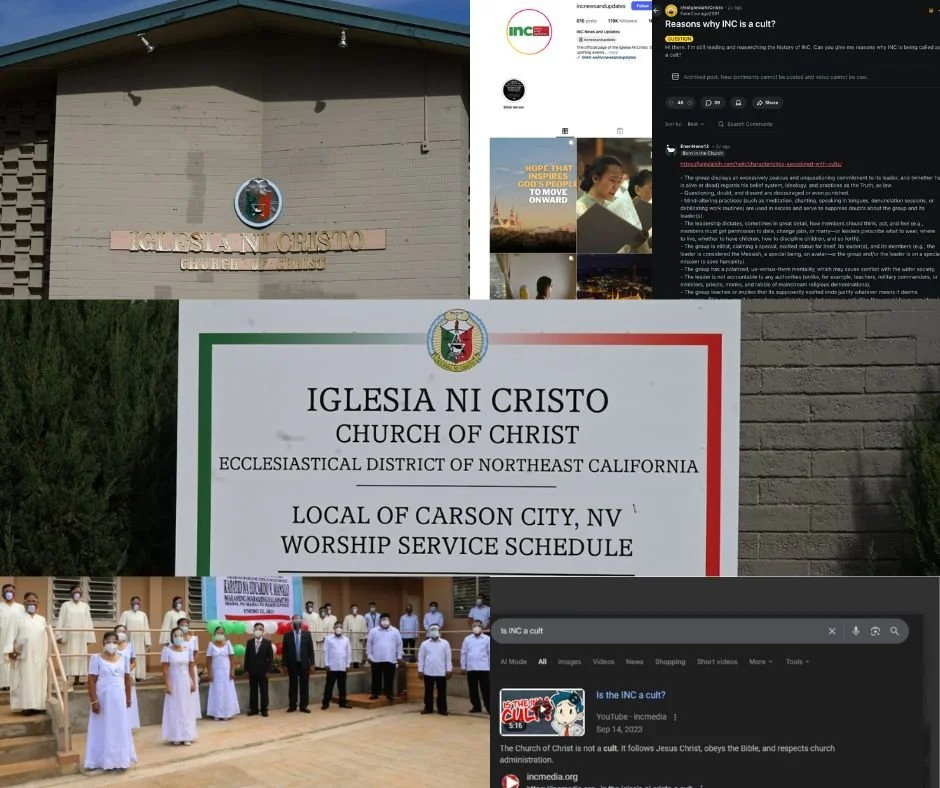
Iglesia Ni Cristo, popular with many religious Filipino Americans including those leaving Catholicism, has two churches in our area, one on Clear Creek Ave in Carson City, and another on Field Street in Sparks.
The church founded in the 1910s in the Philippines has an even bigger presence on social media through its own incmedia productions, including lively conversations on forums such as Reddit discussing whether or not it’s a cult.
The incmedia.org website has its own page with the heading “Is the Iglesia Ni Cristo a Cult?” pointing to a confusing video made to look like a studio television newscast with a host in Quezon City, Philippines, and three guests appearing from Canada, Australia and the United States, mirroring its global reach.
A quick google search on Iglesia Ni Cristo leads to several exposes including one by CBC News in Canada in 2018 called Church of Secrets. “Iglesia Ni Cristo has thousands of followers in Canada, but in the Philippines, some devotees have been accused of kidnapping and murder. This is the story of a Canadian man who ran up against members of the church and ended up dead,” the subhead indicates.
His killing dates back to 2018. Further google searches point to a leadership crisis within the church from 2015 to 2017 with allegations of abductions, disappearances and killings of expelled members and critics. One of them, Felix Villocino was found dead in April 2017 after having gone missing from his Quezon City residence. Another, Jose Norulito Fruto, who was also an American citizen, was shot dead in May 2017 while driving to Cavite, on the southern shores of Manila Bay.
Elijah Reyes, a student at the University of Nevada, Reno, and a member of the reporting team for this project, recently stepped inside a local INC church in Sparks to see for himself whether the controversies surrounding the church reflected reality.
“The set of beliefs upheld by a religious organization says a lot about its true character. The religion that God deems worthy is that which adheres to His teachings written in the Holy Scriptures,” the incmedia.org website indicates. “This is what distinguishes the Iglesia Ni Cristo (Church Of Christ) from other religious groups. It faithfully upholds the teachings of the Bible, which lead to the right spiritual path.”
Reyes grew up in a Filipino household shaped by Catholicism, but he never shared his parents’ attachment to organized religion. Faith was present in his childhood, yet he approached it more as a way for general understanding than as a belief system to adapt to. Over time, he explored other traditions, including Buddhism and Hinduism, not in search of conversion, but to broaden his perspectives. Today, Reyes identifies as agnostic.
His interest in INC developed as he revisited Catholicism and sought a deeper understanding of his Filipino background. The church represented both a cultural touchstone and an institution frequently criticized for its practices, making it a natural point of curiosity.
“I was surprised to learn about a religion native to the Philippines that was not only an offshoot of Christianity, but that also has a controversial history,” Reyes said. “Honestly, I grew anxious about even going to the church after learning about the alleged kidnappings and murders, along with them defending themselves on their own media website”.
Valerie Basco, 20, was an Iglesia Ni Cristo member in the Philippines for nearly three years, joining in late 2020 to meet new people and find her place during the COVID era, before deciding to stop attending.
Raised in a Roman Catholic household in the Philippines, Basco said her entry into INC began through Bible study. “During the pandemic, I had friends who invited me to join some Bible studies in their house. I was interested because their teachings are really different from my previous religion. Their culture is very interesting,” Basco said in an interview with our reporters.
What initially appeared informal, she said, quickly turned into a highly regulated commitment though. She was the first and only one in her family to convert from Catholicism. Out of fear of going against her parents' beliefs, she hid it from them for several months.
To her surprise, when her secret came out, her father had a much different reaction than she feared.
“I thought he was the one who would get really angry, but then he was the one who supported me. First, he said ‘Whatever you want, as long as it doesn't hurt you, and as long as it doesn't affect your studies, just go then,’” Basco remembers.
Her mother, who is a devoted Catholic, had harsher opinions, but these would soften over time. Relieved by her parents' support, Basco continued to attend Iglesia Ni Cristo services.
The church in the Philippines was very strict in its practices, she told us, and the members needed to be very disciplined. “They're allowed outfits like long dresses, like you have to wear blazers, and your shoes must be closed, even for women…also men and women are not allowed to drink alcohol and are not allowed to have tattoos,” Basco said.
If you miss a service, she said members of the church would go to people’s residences to see why they weren’t present. “They will go to your house. They check on you, they ask questions, ask how you’re doing, and ask why you didn’t attend the preaching,” Basco said.
The church had a monthly donation goal they needed to hit, she remembers. The exact amount wasn’t clear, according to her, but she says church officials put pressure on members to donate items as well.
“One time I saw a minister in INC say to a member who is rich, ‘Hey, you should donate a TV or, like, donate money or donate these things.’ And he basically felt forced to do so,” Basco said.
Basco herself was struggling with giving money to the church because she was a student. “As time passed by, I got so busy because I have so many responsibilities here in school, and I don't have the time to be active, and once you join INC, you must be active there,” Basco said.
If a member leaves, she said, their names are publicly called out during the service. “Like my name is removed from the church. I’m not allowed to go back there. I’m not allowed to participate in any INC activities,” she added.
When she finally decided to cut ties, she says she felt sad leaving as there were good people in the church that she would miss. However, there was relief she says as she had felt restricted by the church by not being able to go to parties or having the chance to be young. “As a born Catholic, it’s not my nature. I felt sad but at the same time, I got out of the prison,” Basco said.
Since then, she says she’s currently in the process of returning to Roman Catholicism by attending mass and other church services with her family.
INC was started in the Philippines by Felix Manalo, who is upheld by members as the last messenger of God. “The Iglesia Ni Cristo was preached by Brother Felix Y. Manalo, God’s Messenger in these last days, and was registered in the Philippines on July 27, 1914,” the incmedia website indicates.
In 1968, his son Erano Manalo started the church’s international expansion with a congregation in Honolulu and another in San Francisco, with fast expansion taking place over the next few decades around the world including here in northern Nevada. Iglesia Ni Cristo currently has an estimated 7.000 congregations and missions in over 150 countries.
In Sparks, the exterior of the church blends in with the rest of the neighborhood with its tan walls and its brown gambrel roof. Inside the church, Reyes first noticed the emphasis on structure and control.
A sign near the entrance prohibited phones, cameras, and microphones. An attendance board figured prominently nearby. Through a small window overlooking the sanctuary, he observed that members were seated separately by gender.
“I already felt nervous going inside, and I felt as if I was being trapped as I was being bombarded with restrictions and attendance that I wasn’t familiar with in other churches,” Reyes said.
He then met with a church member to discuss the process of joining INC. He was presented with a form requesting personal information, including his ID, phone number, and place of work, though he was told providing that information was optional. Before leaving, a photo was taken of him to track future attendance.
As he exited, Reyes spoke with several members, some of whom had converted from Catholicism.
“I shared that I was raised as a Catholic who is now an agnostic, and that I was going to be very curious about their faith,” Reyes said. “I was surprised that my curiosity about their faith was welcome and actually something they suggested I do if I continued to attend.”
Although the enrollment process left him uneasy, Reyes said he never felt unsafe inside the church. He left with unanswered questions, uncertain whether the openness he encountered was a carefully managed front or a reflection of genuine belief, or maybe a complex mix of different ingredients.
Feel free to share our story on the below social media: