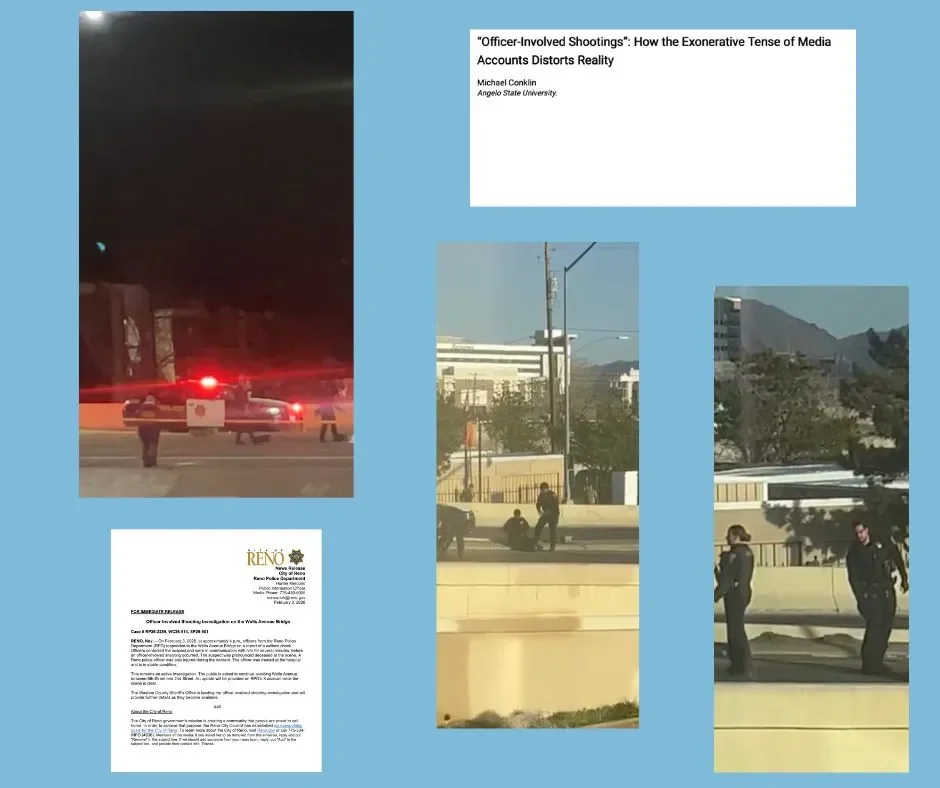
A Ghastly Death on the Wells Avenue Bridge This Week: Why Words and What Actually Happened Matters
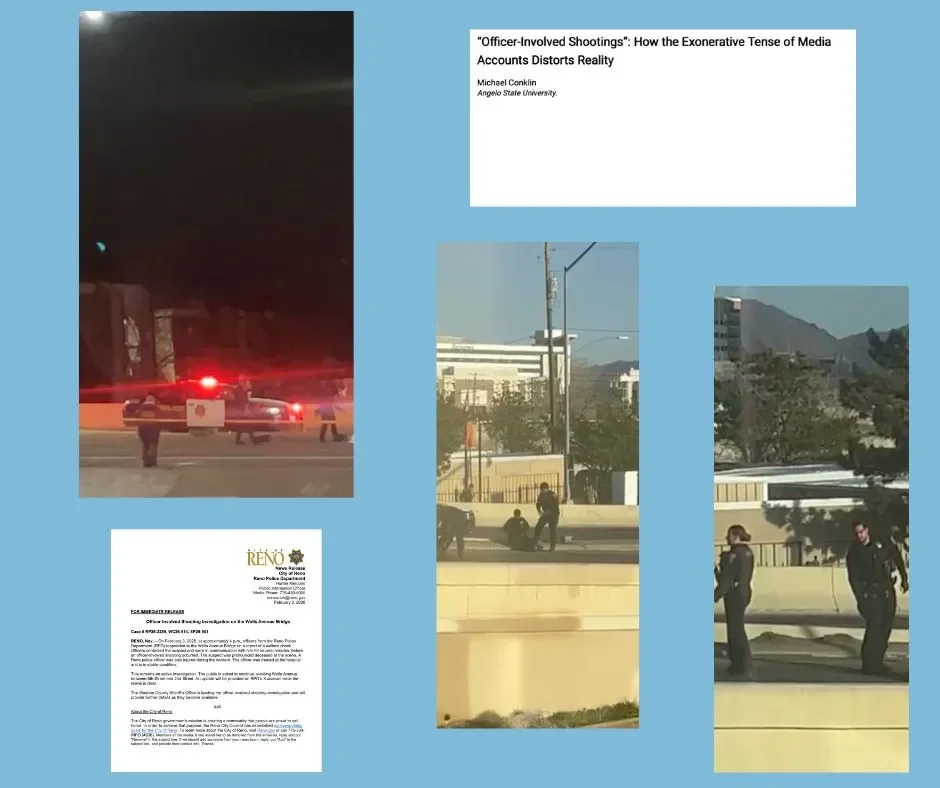
There was a ghastly death earlier this week on Tuesday of a man on the Wells Avenue bridge with many motorists and pedestrians seeing a body on the ground after shots were fired with a police presence on scene.
“At approximately 4 p.m., officers from the Reno Police Department (RPD) responded to the Wells Avenue Bridge on a report of a welfare check,” their press release indicates. “Officers contacted the suspect and were in communication with him for several minutes, before an officer-involved shooting occurred,” it stated.
All other media in town used that terminology but we didn’t. To us it’s purely police vocabulary.
According to the definition an “officer-involved shooting“ which even has its acronym “OIS” “refers to any incident “where a law enforcement officer, either on or off duty, discharges their firearm at a person, regardless of whether anyone is struck, injured, or killed. It generally includes intentional shootings, accidental discharges, and sometimes instances where officers shoot at animals.”
In this case a man was killed or in the words of the Reno PD press release “pronounced deceased at the scene.”
The press release then indicated a Reno police officer was also injured, a point which much of local media focused on much more than the death of the man, with follow up reporting about that.
How did the injury happen? How bad was the injury? What was the injury exactly? What happened at the hospital? None of that was released. Local news indicated the injured officer had been released from the hospital, but no further details were provided.
Under regional protocol, the Washoe County Sheriff’s Office is leading the investigation. Since that’s local law enforcement as well, to us an independent non law enforcement investigation or an independent review board system would seem to provide much more transparency and accountability.
At some point, body cam footage might be released for this killing but that’s not a panacea of truth either. While it can contradict false reports and reduce misconduct, the body cam captures only a limited, obstructed, officer-centric view, and upon release, as law enforcement also often controls this, can be manipulated through selective moments, editing, or failure to record from certain angles.
We got angry comments for the way we wrote about this killing, but to us it’s the media failing the community when they use police jargon and limit themselves to become parallels of police news releases when it’s about an “officer-involved shooting.”
Looking back, the term started in the early 1970s initially by LAPD to describe when police fired on civilians, precisely to attenuate civilian anger.
A recent paper by Michael Conklin with the University of Miami Race and Social Justice review explores “how the use of passive language absolves officers from public and media accountability after a shooting” and “affects public perceptions of police behavior justifications.”
“The phrase “officer-involved shooting” is not just grammatically ambiguous; it also deceptively implies that the officer did not do the shooting,” the paper indicates.
“This is because referring to someone as being “involved” in an act insinuates that he was only involved in some tangential way,” Conklin’s paper goes on. “If the subject was the primary actor, a more direct and active sentence structure should be used. For example, it would be misleading to say that Bernie Madoff was “involved” in a Ponzi scheme. This phrasing implies that Madoff was the victim of the Ponzi scheme or, at worst, played a minor role in enacting it. Madoff was far more than just involved; he was the architect of the scheme. Likewise, when an officer shoots and kills someone, he is more than just involved in the shooting; he carried out the shooting.”
Feel free to share this article on below social media: